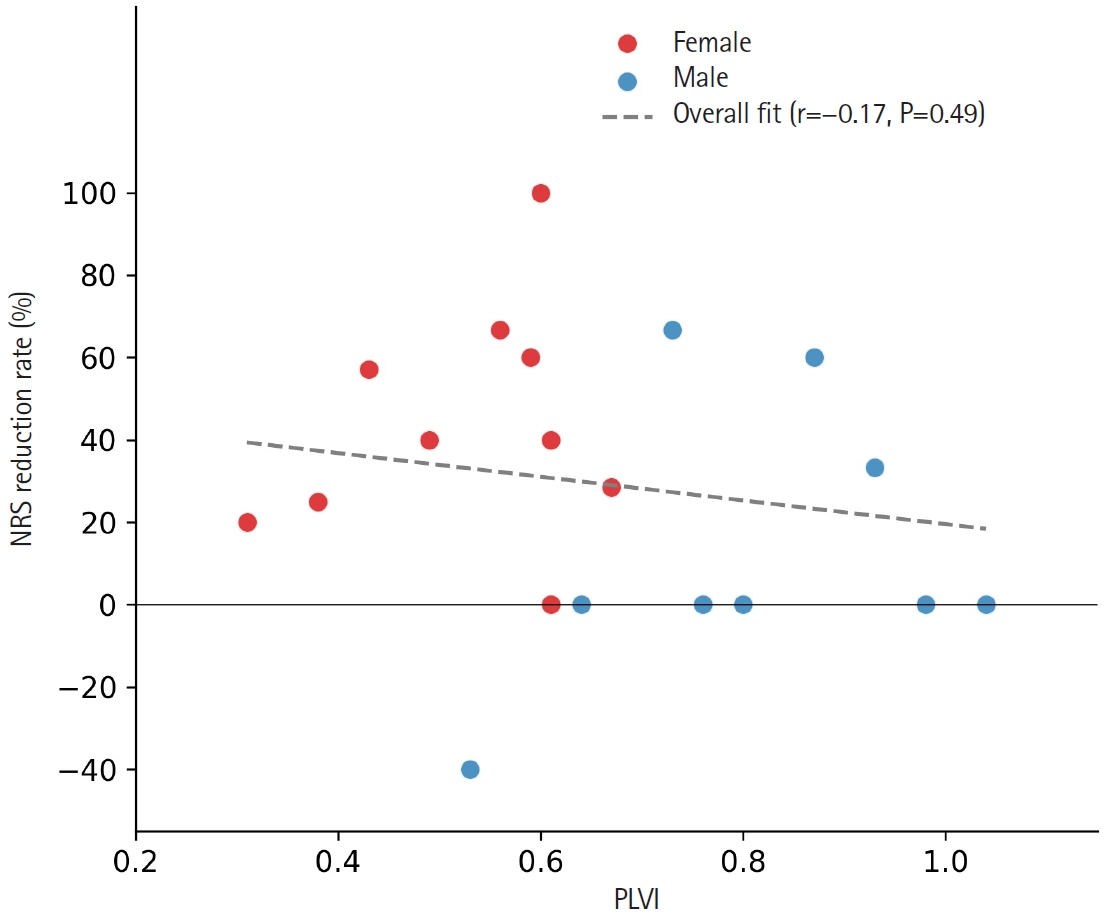
Purpose The psoas–lumbar vertebral index (PLVI), a marker of central sarcopenia measured using computed tomography (CT) or magnetic resonance imaging (MRI), has been linked to the development of postherpetic neuralgia (PHN). Whether PLVI predicts short-term pain relief after pulsed radiofrequency (pRF) treatment of the dorsal root ganglion (DRG) in established PHN remains unknown. This pilot study examined the association between PLVI and the reduction in numeric rating scale (NRS) pain scores 1 month after pRF.
Methods Patients with PHN who underwent DRG pRF and had CT or MRI scans available for PLVI measurement were retrospectively reviewed. Correlations of the NRS reduction rate with PLVI and other variables were assessed, with 95% confidence intervals (CIs). Patients were divided into low- and high-PLVI groups using sex-specific medians and compared; multivariable regression was adjusted for sex. A supplementary responder analysis used thresholds of ≥30% and ≥50% reduction.
Results In 19 patients, NRS scores decreased from 4.8±1.7 to 3.2±1.7, with a reduction rate of 29.3%±34.0%. PLVI was not significantly correlated with the reduction rate (r=−0.17; 95% CI, −0.58 to 0.31; P=0.49); neither the reduction rate (P=0.71) nor responder rates differed between the low- and high-PLVI groups. Male sex was associated with a smaller reduction (adjusted B=−47.2 percentage points; 95% CI, −90.9 to −3.5; P=0.036), although the unadjusted group comparison was not significant (Welch P=0.051) and 15 variables were tested without correction for multiple comparisons.
Conclusion This pilot cohort showed no detectable association between PLVI and short-term pain relief after pRF; its small size precludes establishing the absence of an association. The exploratory sex difference warrants investigation in larger prospective studies with comprehensive sarcopenia assessment.
Purpose Rectus sheath block (RSB) is a simple abdominal wall block that can be readily applied. This study evaluated the postoperative analgesic efficacy of ultrasound-guided bilateral RSB in robotic single-site gynecologic surgery.
Methods Sixty patients were randomly assigned to the RSB group (n=30) or the control group (n=30). After induction of general anesthesia, patients in the RSB group received ultrasound-guided bilateral RSB with 30 mL of 0.25% ropivacaine. Pain intensity was assessed using a verbal numerical rating scale (VNRS) at 0, 1, 6, 12, 24, and 48 hours postoperatively. Intravenous patient-controlled analgesia was provided to all patients, and fentanyl was administered as rescue analgesia on request.
Results VNRS scores at 0, 1, and 6 hours were significantly lower in the RSB group than in the control group (all P<0.05). Rescue fentanyl use in the post-anesthesia care unit was also significantly lower in the RSB group than in the control group (19.8±21.0 μg vs. 46.3±27.6 μg, P<0.001). Subgroup analysis showed that RSB was associated with lower VNRS scores in patients undergoing ovarian surgery or myomectomy, whereas no significant difference was observed in patients undergoing hysterectomy.
Conclusion Ultrasound-guided bilateral RSB reduced early postoperative pain and rescue analgesic requirements after robotic single-site gynecologic surgery.


 , Eunbi Cho

 First
 Prev