


• Contact us
  • E-Submission
ABOUT
BROWSE ARTICLES
JOURNAL POLICIES
FOR CONTRIBUTORS

Page Path

2
results for

"Anastomotic leak"

Filter

Article category

Keywords

Publication year

Authors

"Anastomotic leak"

Original article

[English]
Endoscopic vacuum therapy for gastrointestinal transmural defects: clinical outcomes and treatment implications: a retrospective study from Korea
A Reum Choe, Ki-Nam Shim, Ju-Ran Byeon, Yehyun Park, Eun Mi Song, Chung Hyun Tae, Sung-Ae Jung
Ewha Med J 2026;49(1):e4.   Published online January 21, 2026
DOI: https://doi.org/10.12771/emj.2025.01025
Purpose
Endoscopic vacuum therapy (EVT) has emerged as a highly effective approach for managing gastrointestinal transmural defects and may offer advantages over traditional methods, such as stenting. This study evaluated the clinical outcomes of EVT for gastrointestinal transmural defects resulting from leakages, perforations, and fistulas.
Methods
We retrospectively reviewed patients who underwent EVT for gastrointestinal transmural defects at Ewha Womans University Medical Center between February 2018 and September 2025 and analyzed clinical outcomes, adverse events, and risk factors associated with adverse events.
Results
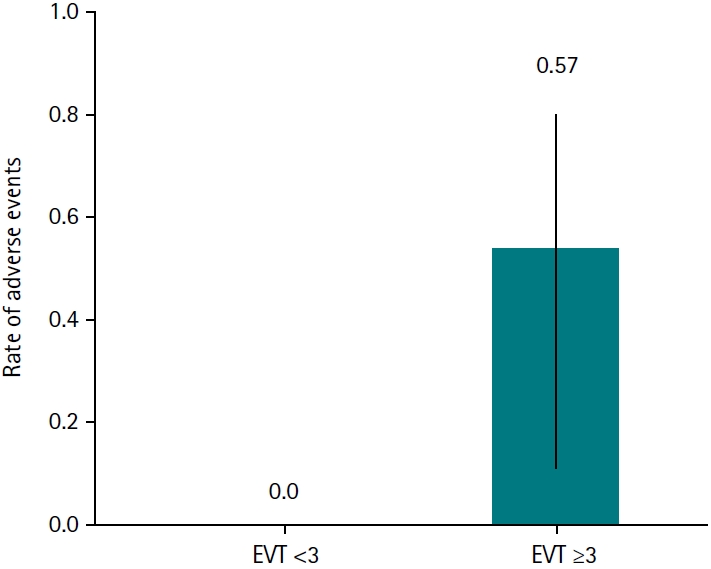
Fourteen patients were included (mean age, 63.9 years; 85.7% male). Stomach surgery was the most common etiology (50.0%), and malignancy accounted for 71.4% of cases. The median number of EVT sessions was 2.5, and the mean interval from the index event to the first EVT session was 10.5 days. EVT achieved a 100% technical success rate, with no 30-day mortality; there was 1 in-hospital death (7.1%), 2 cases of stricture (14.3%), and 1 major bleeding event (7.1%). Adverse events were observed more frequently in patients who underwent ≥3 EVT sessions (57.1%) compared with those who underwent <3 sessions, in whom no adverse events occurred.
Conclusion
This study suggests that EVT is a safe and effective treatment for gastrointestinal transmural defects, with high technical success rates. The number of EVT sessions and the timing of treatment initiation appeared to be associated with complications and overall clinical outcomes.
  • 379 View
  • 27 Download
Review Article
[English]
Preventing Anastomotic Leakage, a Devastating Complication of Colorectal Surgery
Hyun Gu Lee
Ewha Med J 2023;46(s1):e29.   Published online December 31, 2023
DOI: https://doi.org/10.12771/emj.2023.e29
ABSTRACT

Anastomotic leakage (AL) after colorectal surgery is a significant concern, as it can lead to adverse functional and oncologic outcomes. Numerous studies have been conducted with the aim of identifying risk factors for AL and developing strategies to prevent its occurrence, thereby reducing the severe morbidity associated with AL. The intraoperative method for reducing AL includes a mechanical assessment of AL, an assessment of bowel perfusion, drain placement, and the creation of diverting stomas. The anastomosis technique is also associated with AL, and the appropriate selection and accurate application of anastomotic methods are crucial for preventing AL. Indocyanine green fluorescence imaging has recently gained popularity as a method for assessing bowel perfusion. While it is useful for detecting bowel perfusion, standardized protocols and measurement methods need to be established to ensure its reliability and effectiveness in clinical practice. The use of intraoperative drains to reduce AL has produced inconsistent results, and the routine adoption of this practice is not currently recommended. Diverting stomas can be used to help reduce the morbidity associated with AL. However, it is important to carefully consider the complications that can arise directly from the stoma itself. It should be noted that while a stoma can reduce AL, it cannot completely prevent it. This descriptive review examines various intraoperative methods aimed at reducing AL, discussing their effectiveness in reducing AL.

Citations

Citations to this article as recorded by  
  • Gut microbiota and postoperative complications in colorectal surgery and its potential association with intestinal permeability and NLRP6 inflammasome
    Manuel Buitrago-Ruiz, Celia Arias-Sánchez, Maria Magdalena Asensio-López, Juan José Martínez-García, Victoriano Soria-Aledo, Graciela Valero-Navarro, Santiago Cuevas
    Frontiers in Immunology.2026;[Epub]     CrossRef
  • Taming colonic anastomotic leakage: Wisdom from the ancient Chinese legend of Yu the Great
    Chao Jing, Kun Liu
    World Journal of Gastrointestinal Surgery.2025;[Epub]     CrossRef
  • Emerging Infectious Diseases at the End of the Fourth Year of the COVID-19 Pandemic and Recent Updates on Colorectal and Pediatric Endocrine Diseases
    Sun Huh
    The Ewha Medical Journal.2023;[Epub]     CrossRef
  • 5,706 View
  • 28 Download
  • 3 Crossref
TOP