


• Contact us
  • E-Submission
ABOUT
BROWSE ARTICLES
JOURNAL POLICIES
FOR CONTRIBUTORS

Page Path

2
results for

"Epidural space"

Filter

Article category

Keywords

Publication year

Authors

"Epidural space"

Case report

[English]
Pneumocephalus with suspected cerebrospinal fluid leakage after epiduroscopic epidural neuroplasty: a case report
Min Jeong Kang, Bo Kyung Kang, Seung Hee Yoo, Won-joong Kim
Ewha Med J 2026;49(3):e23.   Published online July 14, 2026
DOI: https://doi.org/10.12771/emj.2026.01459
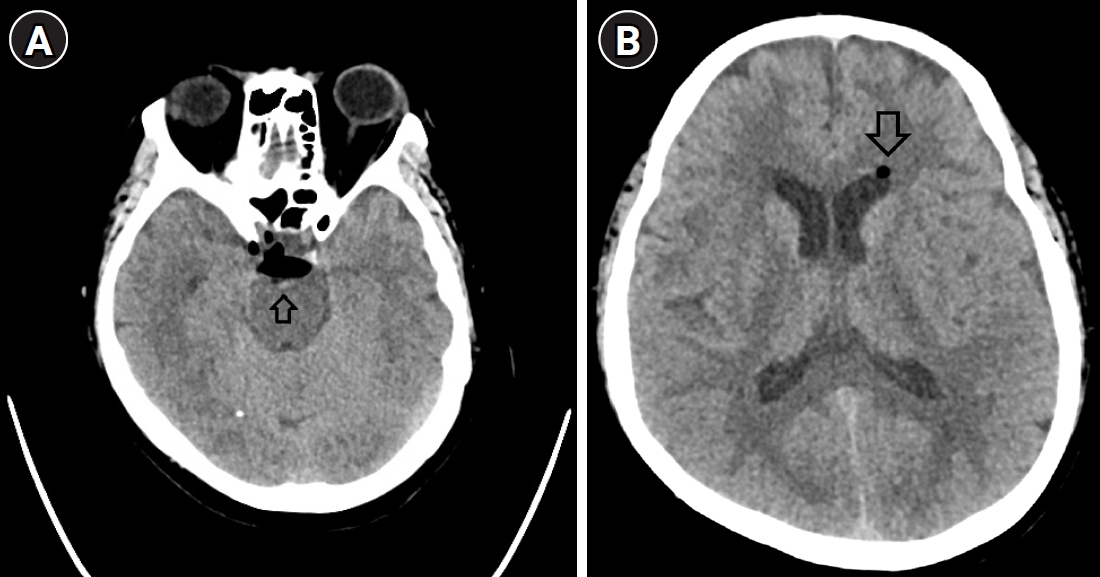
Pneumocephalus is a rare complication of neuraxial procedures and is usually associated with inadvertent dural puncture or the use of air during epidural space identification. Epiduroscopic epidural neuroplasty (EEN) is performed without air injection and permits direct visualization of the epidural space; therefore, pneumocephalus after this procedure is extremely uncommon. A 71-year-old woman with a history of lumbar spine surgery underwent EEN via a caudal approach without sedation. No dural puncture was identified during the procedure. Approximately 12 hours later, she developed a non-orthostatic headache. Brain computed tomography revealed pneumocephalus in the basal cistern and left lateral ventricle. Her symptoms improved with oxygen therapy but worsened 5 days later despite radiologic resolution of the pneumocephalus. Suspected cerebrospinal fluid (CSF) leakage was treated with an epidural blood patch, which resolved her symptoms. Pneumocephalus may occur after EEN without clinically or endoscopically recognized dural injury and may coexist with CSF leakage; an occult microdural defect cannot be excluded as the underlying mechanism. Prompt imaging should be considered in patients who develop early or atypical postprocedural headache.
  • 357 View
  • 10 Download
Original Article
[English]
The Effect of Pregnancy and Posture on the Distance from Skin to Epidural Space
Rack Kyung Chung
Ihwa Ŭidae chi 1996;19(4):521-525.   Published online July 24, 2015
DOI: https://doi.org/10.12771/emj.1996.19.4.521
Objectives

This study was performed to assess the factor affecting the distance from skinto epidural space.

Methods

The distance from the skin to epidural space(DSES) was measured in 105 patients who received lumbar epidural anesthesia. The relationship between patient factors [age, weight, height, body mass index(BMI : weight/height2), pregnancy] and technical factor(posture) versus DSES was investigated using multiple regression analysis.

Results

The mean DSES was 4.5±0.7cm. DSES correlated positively with weight and BMI in non-obstetrics(including male), and BMI in obstetrics. But, DSES did not correlated with posture.

Conclusion

The patient's weight and BMI in non-obstetrics and BMI in obstetrics but posture during epidural needle placement are important factors influencing DSES.

  • 572 View
  • 1 Download
TOP