Purpose Clinical fieldwork in genetic counseling education is constrained by limited training sites, shortages of clinical supervisors, and administrative burdens. Simulation-based learning, including role-play, has therefore been used to support development of counseling competencies. This study described the development, implementation, operational structure, and feasibility of a role-play-based practicum in a graduate genetic counseling program.
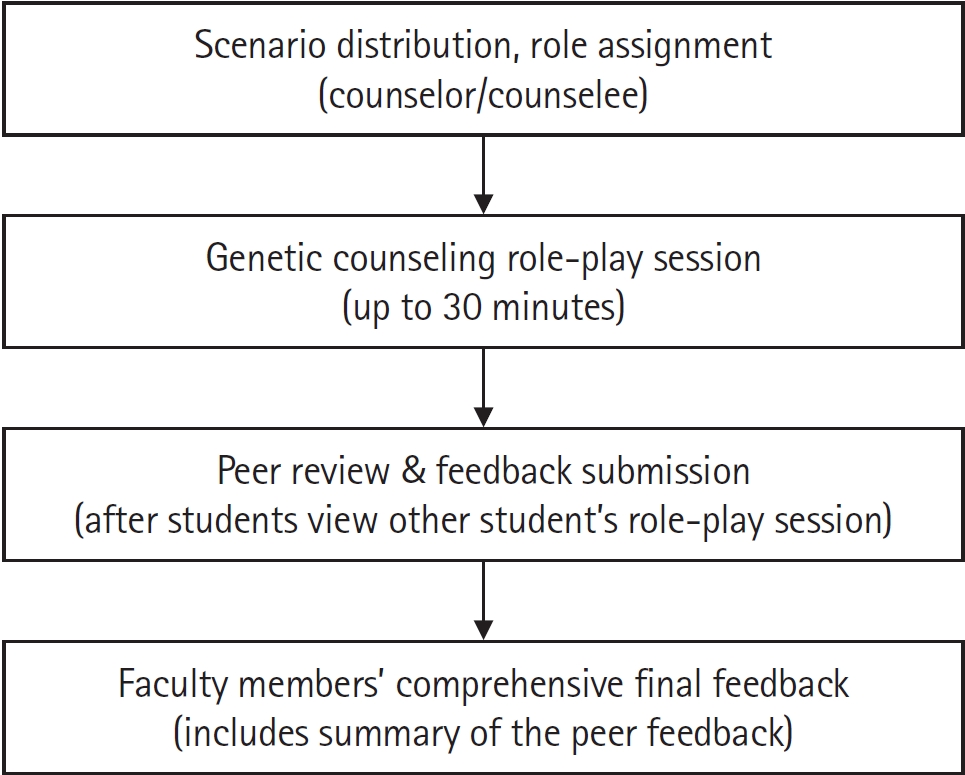
Methods This retrospective descriptive report was based on Genetic Counseling Practicum, a spring 2024 course for 11 third-semester students in a graduate genetic counseling program in South Korea. Twenty-two role-play scenarios were developed, including 11 hereditary cancer cases and 11 pediatric or adult genetic disorder cases. The scenarios simulated pretest and posttest encounters during a 6-week, 2-block practicum. Students alternated between counselor and counselee roles, recorded sessions outside class time, and received domain-guided peer and faculty feedback.
Results The scenarios covered patient ages from infancy to late adulthood and included somatic and germline pathogenic variants, a negative multigene panel result, and chromosomal or epigenetic abnormalities. All 22 planned sessions were completed and recorded as scheduled, and all 11 students completed their assigned sessions. The planned assignment, recording, review, and feedback procedures were completed without documented omissions. Approximately 11 scheduled class hours were devoted to feedback, and no external clinical sites or supervisors were required.
Conclusion This study presents an operationally feasible model for a role-play-based practicum with diverse scenarios in a graduate genetic counseling curriculum. It may serve as a practical reference for programs considering similar simulation-based training.
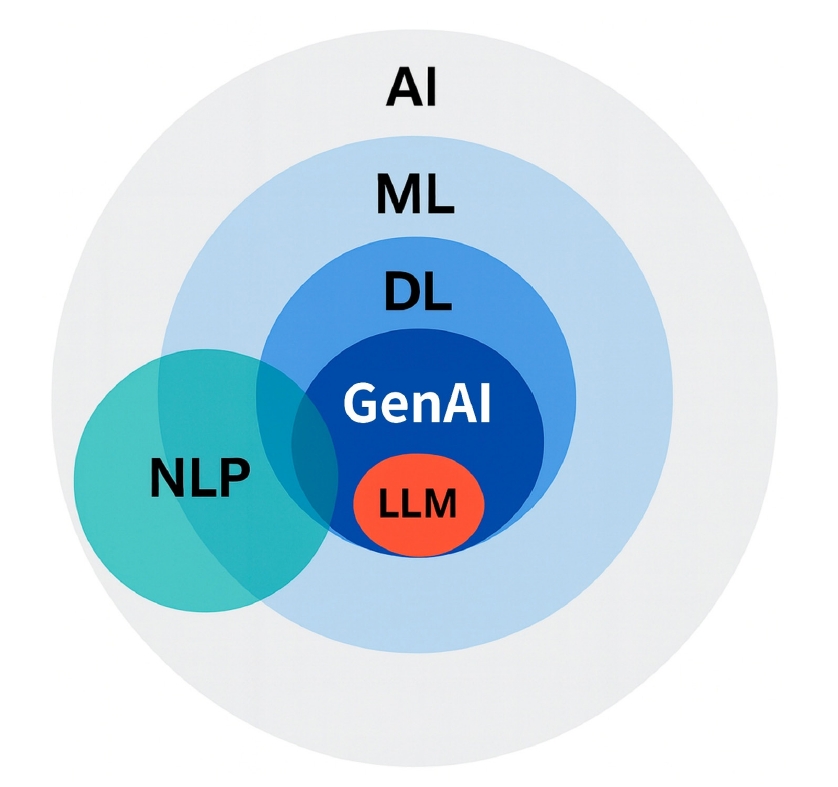
Generative artificial intelligence (GenAI), including large language models such as GPT-4 and image-generation tools like DALL-E, is rapidly transforming the landscape of medical education. These technologies present promising opportunities for advancing personalized learning, clinical simulation, assessment, curriculum development, and academic writing. Medical schools have begun incorporating GenAI tools to support students’ self-directed study, design virtual patient encounters, automate formative feedback, and streamline content creation. Preliminary evidence suggests improvements in engagement, efficiency, and scalability. However, GenAI integration also introduces substantial challenges. Key concerns include hallucinated or inaccurate content, bias and inequity in artificial intelligence (AI)-generated materials, ethical issues related to plagiarism and authorship, risks to academic integrity, and the potential erosion of empathy and humanistic values in training. Furthermore, most institutions currently lack formal policies, structured training, and clear guidelines for responsible GenAI use. To realize the full potential of GenAI in medical education, educators must adopt a balanced approach that prioritizes accuracy, equity, transparency, and human oversight. Faculty development, AI literacy among learners, ethical frameworks, and investment in infrastructure are essential for sustainable adoption. As the role of AI in medicine expands, medical education must evolve in parallel to prepare future physicians who are not only skilled users of advanced technologies but also compassionate, reflective practitioners.
Citations
Citations to this article as recorded by
Using virtual reality to support the transition from preclinical to clinical training in paediatric dentistry Marion Lautier, Faustine Béal, Amélie Reibel Domergue, Sophie Jung, François Clauss, Marion Strub BMC Medical Education.2026;[Epub] CrossRef
Generative and Large-Scale Artificial Intelligence in Exercise and Sports Medicine: A Narrative Review Bokyoung Kim, Junseok Kang, Yun Jae Jung, Jihyun Ahn The Asian Journal of Kinesiology.2026; 28(1): 58. CrossRef
Bridging the Implementation Gap in Medical AI Education: 3-Lever Framework for Concurrent Reform Sherrie L Kelly, Melissa Forgie, Mark C Walker JMIR Medical Education.2026; 12: e88778. CrossRef
A dialectical lens for AI and medical humanities: advancing responsible augmented humanism in Digital Public Health Sifan Chen, Zining Peng, Nian Liu Frontiers in Public Health.2026;[Epub] CrossRef
Artificial Intelligence in Psychiatry Training: Comparative Insights from Nine Large Language Models Across Cultural and Exam Contexts Yusuf Selman Çelik, Nagihan Özer, Makbule Esen Öksüzoğlu, Şeyma Selcen Macit, Hande Günal Okumuş, Meryem Kaşak, Ayşegül Efe, Yusuf Öztürk Psychiatric Quarterly.2026;[Epub] CrossRef
AI-supported case-based learning in medical education: a comprehensive scoping review Syed Hani Abidi, Joseph Almazan, Olaoluwa Fabiyi, Fatin Zehra, Muhammad Tariq Frontiers in Medicine.2026;[Epub] CrossRef
Evaluation of the Effectiveness of Psychological First Aid Training for Community Nurses in China: A Quasi‐Experimental Study on Knowledge and Skills Enhancement Yazhou He, Yulan Ding, Jiaqin Yan, Xiaoning Xiong, Shan Huang, Sijian Li Nursing Open.2026;[Epub] CrossRef
Generative AI–Assisted Microlearning for Erectile Dysfunction Myth Reduction: Single-Center Pre–Post Quasi-Experimental Study Ali Can Albaz, Oğuzcan Erbatu, Okan Yiğit, Oktay Üçer, Gökhan Temeltaş, Talha Müezzinoğlu JMIR Formative Research.2026; 10: e88818. CrossRef
Implementation of artificial intelligence in the 2025 medical parasitology course at Hallym University Eun Hee Ha Journal of Educational Evaluation for Health Professions.2026; 23: 4. CrossRef
Bridging theory and practice in generative artificial intelligence for medical education: insights from clinical teaching experience Yoo Kyung Lee Ewha Medical Journal.2026; 49(2): e16. CrossRef
Design and Evaluation of a Faculty Development Workshop Series on Integrating Generative Artificial Intelligence in Medical Education: Mixed Methods Pilot Study Rajalakshmi Anand, Nicole Bowers, Mange Festo Manyama JMIR Medical Education.2026; 12: e89815. CrossRef
An exploration of undergraduate nursing students' heavy use of generative artificial intelligence in academic practice: A descriptive phenomenological study Xiaoqing Wang, Kai Yu, Weiliang Wang, Jiyue Li, Yuexian Shi International Journal of Nursing Studies.2026; 180: 105557. CrossRef
Use of large language models for providing automated feedback in medical imaging education: a systematic review Mustafa Mohammed Al-Mashhadani, Faika Ajaz, Shaista Salman Guraya, Farah Ennab Frontiers in Medicine.2026;[Epub] CrossRef
Generative artificial intelligence and large language models in competency-based medical education: applications, challenges, and future directions In Hwa Jeong, Heeyoung Kim, Hyunyong Hwang Kosin Medical Journal.2026; 41(2): 114. CrossRef
The role of artificial intelligence in personalising the teaching process at medical universities Daniel Ślęzak Humanities & Social Sciences Reviews.2026; 14(2): 67. CrossRef
The Pocket Tutor - Generating Competency-Based Clinical Vignettes with Artificial Intelligence for Medical Postgraduate Competitive Exam Preparation Swapnil Banerjee, Manisha Agarwal Galore International Journal of Health Sciences and Research.2026; : 69. CrossRef
Benefits and challenges of integrating generative AI in health technology education—a case study Minna Pikkarainen, Marko Lukic, Safora Johanssen, Wilfried Admiraal, Arild Berg, Yngve Røe Frontiers in Education.2026;[Epub] CrossRef
Benchmarking five large language models in medical genetics: a bilingual comparative evaluation using published and novel expert-authored questions Özge Beyza Gündoğdu Öğütlü, Benjamin D. Solomon, Yusuf Selman Çelik Frontiers in Medicine.2026;[Epub] CrossRef
Epistemología de la praxis médica en la era de la inteligencia artificial: metacognición, metodologías activas y personalización del aprendizaje por competencias en el siglo XXI Fernando Vanegas Lara, Mariel Gonzalez-Calatayud, Omar Hassiri Gómez Gómez, Roberto Méndez Pérez Educación Médica.2026; 27(6): 101246. CrossRef
Use of Expert-Validated AI-Generated Forensic Images in Case-Based Learning and Clinical Reasoning Among Undergraduate Medical Students: A Two-Arm Educational Intervention Study Priyanka Chahal, Abhishek Sharma, Arindam Chatterjee Cureus.2026;[Epub] CrossRef
Inteligencia artificial y razonamiento clínico en educación médica: una revisión sistemática Rafael Emiliano Sulca Quispe, Juan Miguel Purilla Janto, María del Rosario Jáuregui-Figueroa, María del Rosario Figueroa Bejarano De Jauregui Revista Simón Rodríguez.2026; 6(13): 1. CrossRef


 , Min Seon Park
 , Jihyun Ahn

 First
 Prev