

 , Bo Eun Lee , Hyung Jun Park, Kyoung-Gyu Choi, Key Hwan Lim, Kee Duk Park
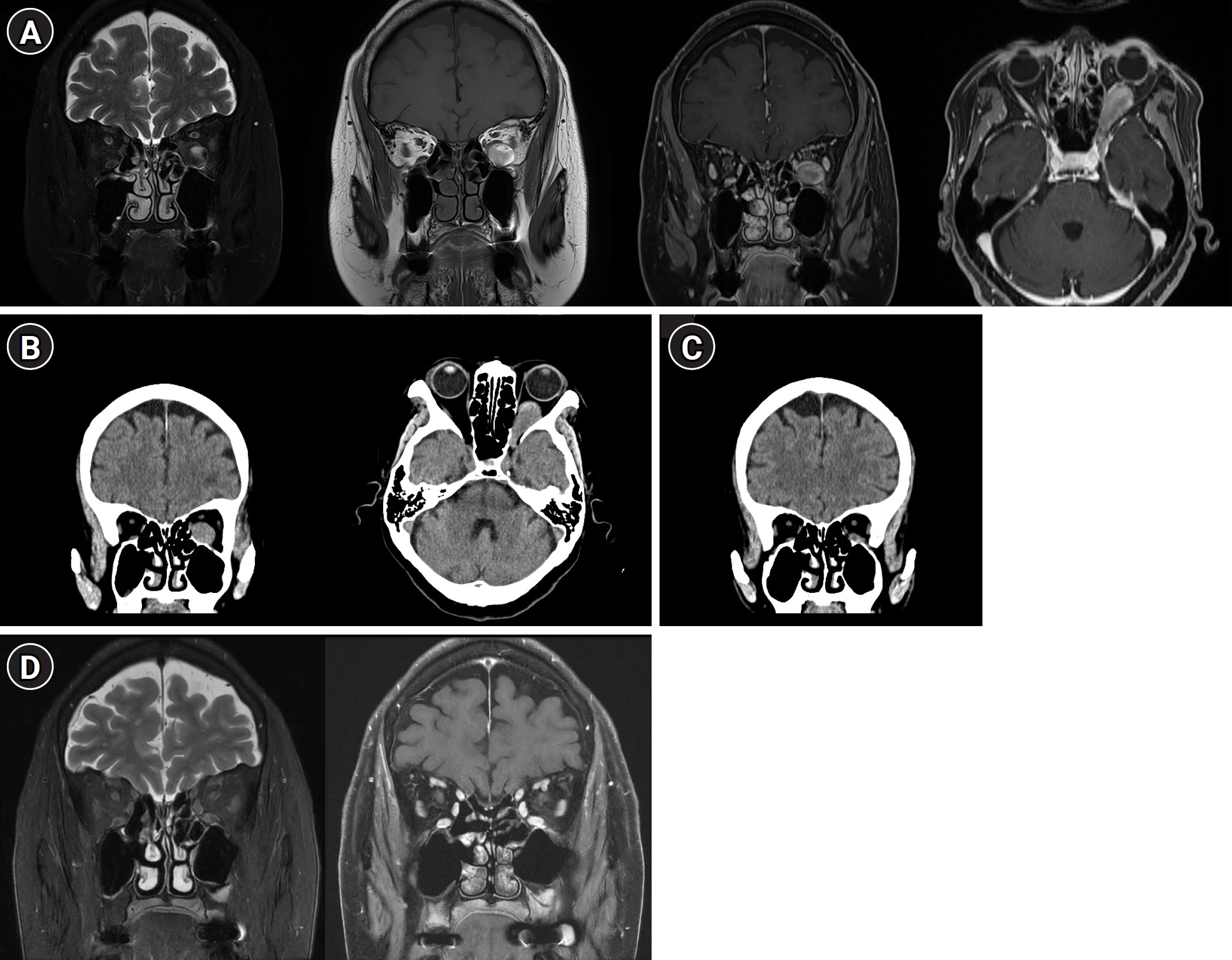
Orbital metastases are rare and predominantly unilateral occurrences. Bilateral metastases affecting the extraocular muscles are extremely rare. A few case reports of bilateral metastases to extraocular muscles described binocular diplopia with conspicuous bilateral external ophthalmoplegia as an initial symptom. We report a case in which unilateral ptosis was an initial symptom and bilateral incomplete ophthalmoplegia was found on initial neurologic examination in invasive ductal carcinoma of the breast. The patient had hormone receptor-positive breast cancer, and so was treated by hormonal therapies and closely monitored. The presence of a secondary orbital lesion presents many difficulties of differential diagnosis and treatment. A thorough neurologic examination to detect ocular manifestations is most important for localization and broad differential diagnosis including mechanical orbital metastatic lesion.
Citations
 , Jun-Hyeok Song, Myung-Hyun Kim
The approaches for skull base lesions should allow excellent visualization, minimized working distance and avoid brain retraction. We consider the supraorbital approachto be the approach of choice for orbital, anterior and middle cranial fossae lesions. Thetechnique of procedure is described and reviewed its advantages.
the authors reviewed the eleven cases which were operated bysupraorbital approach and one case which were operated by supraorbital bifrontal approach,from May 1992 to May 1996.
Eleven patients(four cases of tuberculum sellae meningiomas, one case of pituitarymacroadenoma, two case of suprasellar germinoma, one case of cavernous hemangioma in theorbit, two cases of huge size of craniopharyngiomas, one case of optie and oculomotor nervepalsy due to compound fiacture of orbit) were cured or improved with the supraorrbtal andsupraorbito-bifrontal approsch. But one case of suprasellar germinoma died.
The supraorbital approach is preferred in lesions of orbital, anterior and middlecranial fossae, because it minimize brain retraction, shorten the distance of the target of lesionsand provide multiple pathways for dissection of the lesions. Also this approach may combinewith other skull base approaches.
 First
 Prev