


• Contact us
  • E-Submission
ABOUT
BROWSE ARTICLES
JOURNAL POLICIES
FOR CONTRIBUTORS

Page Path

2
results for

"Pneumocephalus"

Filter

Article category

Keywords

Publication year

Authors

"Pneumocephalus"

Case report

[English]
Pneumocephalus with suspected cerebrospinal fluid leakage after epiduroscopic epidural neuroplasty: a case report
Min Jeong Kang, Bo Kyung Kang, Seung Hee Yoo, Won-joong Kim
Ewha Med J 2026;49(3):e23.   Published online July 14, 2026
DOI: https://doi.org/10.12771/emj.2026.01459
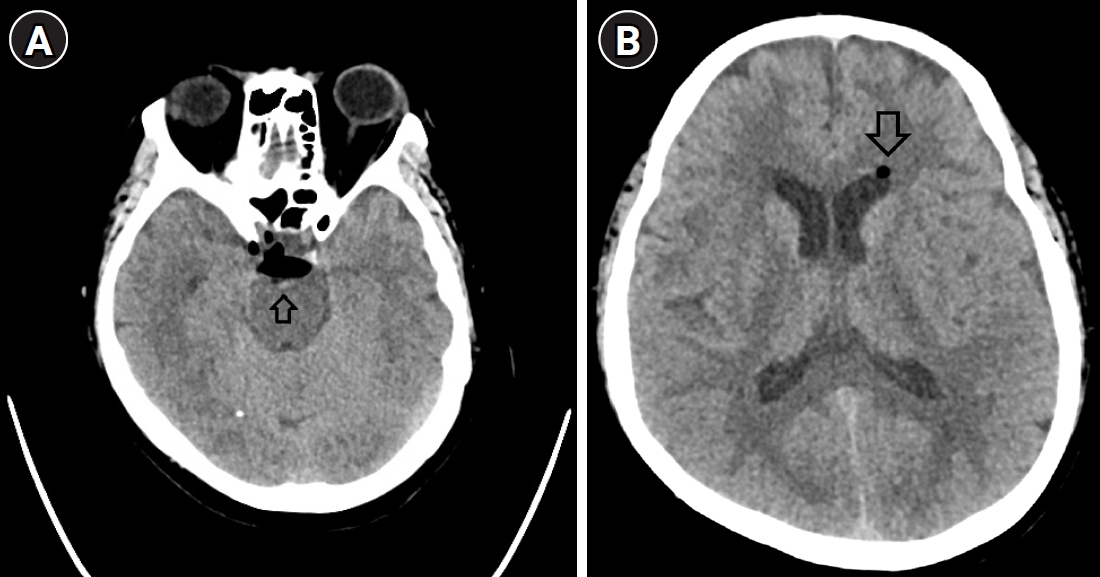
Pneumocephalus is a rare complication of neuraxial procedures and is usually associated with inadvertent dural puncture or the use of air during epidural space identification. Epiduroscopic epidural neuroplasty (EEN) is performed without air injection and permits direct visualization of the epidural space; therefore, pneumocephalus after this procedure is extremely uncommon. A 71-year-old woman with a history of lumbar spine surgery underwent EEN via a caudal approach without sedation. No dural puncture was identified during the procedure. Approximately 12 hours later, she developed a non-orthostatic headache. Brain computed tomography revealed pneumocephalus in the basal cistern and left lateral ventricle. Her symptoms improved with oxygen therapy but worsened 5 days later despite radiologic resolution of the pneumocephalus. Suspected cerebrospinal fluid (CSF) leakage was treated with an epidural blood patch, which resolved her symptoms. Pneumocephalus may occur after EEN without clinically or endoscopically recognized dural injury and may coexist with CSF leakage; an occult microdural defect cannot be excluded as the underlying mechanism. Prompt imaging should be considered in patients who develop early or atypical postprocedural headache.
  • 357 View
  • 10 Download
Original Article
[English]
The Incidence of Pneumocephalus after Cerebral Aneurysm Surgery
Eun Ju Paik, Jong In Han, Rack Kyung Chung, Guie Yong Lee, Chi Hyo Kim, Jong Hak Kim, Choon Hi Lee, Hae Young Choi
Ihwa Ŭidae chi 1997;20(2):247-250.   Published online July 24, 2015
DOI: https://doi.org/10.12771/emj.1997.20.2.247
Objectives

Pneumocephalus is a pathologic collection of gas within the cranial cavity. Patients undergoing neurosurgical procedures may be at increased risk for the development of tension paneumocephalus if nitrous oxide(N2O) is used during a subsequent anesthetic.

Methods

Thirty-seven patients undergoing cerebral aneurysm surgery had a computed tomographic scan of the head performed on or after the day of their surgery. 64 scans were examined for the presence of intracranial air. The magnitude of pneumocephalus was recorded as A-P(mm), width(m),& numbers of section.

Results

Air was seen in all scans obtained in the first three postoperative days, During the second postoperative weeks, the incidence and the size of pneumocephalus decreased. A significant number of patients have an intracranial air collection in the first two weeks after the procedure.

Conclusion

These data indicate that all patients have pneumocephalus immediately after a cerebral aneurysm surgery. This information should be considered in the evaluation of the patient and the selection of anesthetic agents during a second anesthetic in the first 2 weeks after the first procedure.

  • 639 View
  • 0 Download
TOP