

• Contact us
  • E-Submission
ABOUT
BROWSE ARTICLES
JOURNAL POLICIES
FOR CONTRIBUTORS

Page Path

2
results for

"Uterine cervical neoplasms"

Filter

Article category

Keywords

Publication year

Authors

"Uterine cervical neoplasms"

Original article

[English]
Immunohistochemical expression of Ki-67, estrogen receptor, and human epidermal growth factor receptor 2 in p16-positive premalignant and malignant cervical squamous lesions: associations with clinicopathological parameters
Ashwini Pitambra, Jitendra Singh Nigam, Immanuel Pradeep, Ashutosh Rath, Seetu Palo, Naina Kumar

Received December 10, 2025  Accepted January 19, 2026  Published online January 28, 2026  
DOI: https://doi.org/10.12771/emj.2025.01088    [Epub ahead of print]
Purpose
Human papillomavirus is the dominant etiological factor underlying atypical cervical squamous epithelial cell abnormalities and cervical carcinoma. Currently, only a limited number of drugs targeting specific biomarkers in cervical cancer are available. This study aimed to assess the expression of estrogen receptor (ER), human epidermal growth factor receptor 2 (HER2), and the Ki-67 proliferative index (Ki-67) in p16-positive cervical squamous premalignant and malignant lesions, which may help clarify the potential role of targeted therapies in cervical cancer.
Methods
In p16-positive, histologically proven premalignant and malignant cervical lesions, ER, HER2, and Ki-67 expression were evaluated according to predefined criteria.
Results
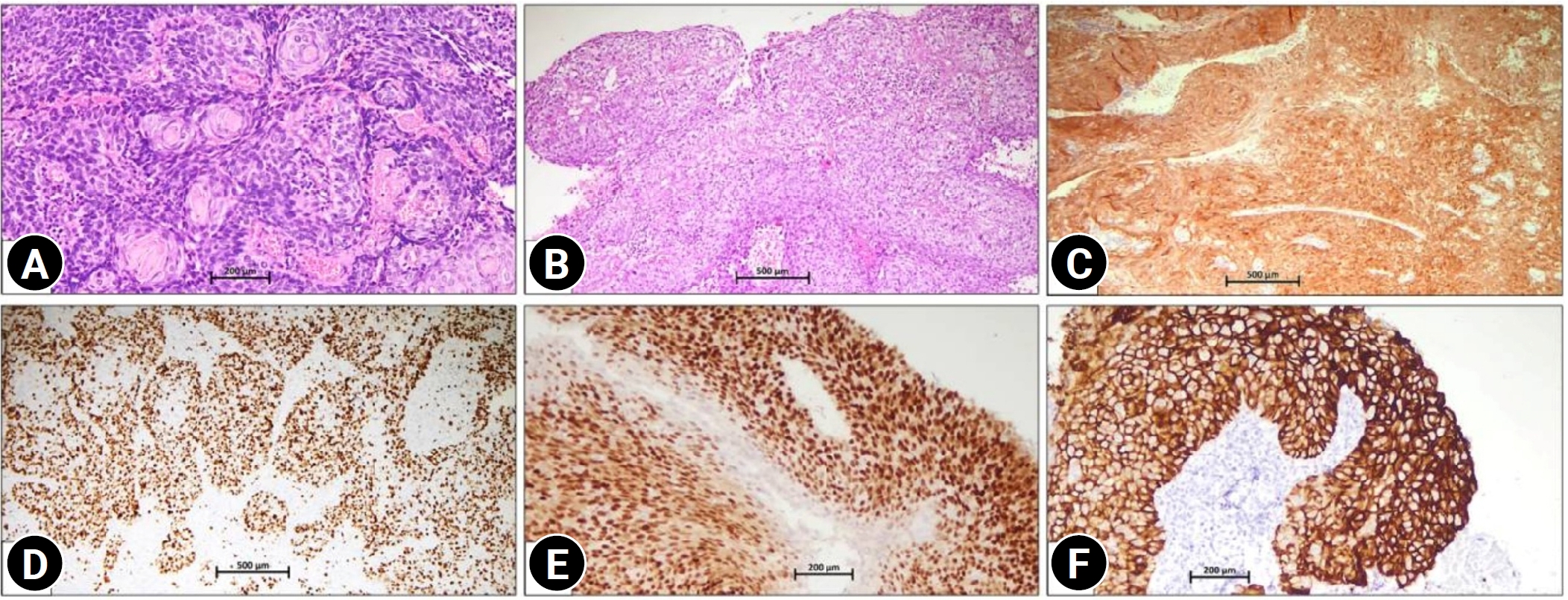
p16 showed strong nuclear and cytoplasmic positivity in 54 of 56 cases. Patchy nuclear positivity was mainly observed in low-grade squamous intraepithelial lesion (LSIL) cases (2/56). Ki-67 demonstrated a variable proliferative index ranging from 5% to 95% across all cases, with higher indices predominantly observed in squamous cell carcinomas (SCC). ER positivity in LSIL, high-grade squamous intraepithelial lesion, and SCC was 100% (2/2), 66.7% (10/15), and 46.15% (18/39), respectively. HER2 expression was predominantly negative, observed in 78.6% (44/56) of cases, equivocal in 17.8% (10/56), and positive in 3.6% (2/56). Both HER2-positive cases were SCC. ER and HER2 interpretations were analyzed and were not significantly correlated with clinical or pathological parameters.
Conclusion
ER positivity decreased with progression of cervical squamous lesions, and HER2 expression was rare in cervical squamous neoplasia. No statistically significant correlation was identified between ER or HER2 expression and clinicopathological parameters. The findings of the current study may help fill gaps in the existing literature and provide essential foundational knowledge for optimizing emerging therapeutic strategies, including ER- and HER2-related therapies.
  • 114 View
  • 9 Download
Case Report
[English]
Primary Lymphoma of Cervix
Ji Eun Shim, Juhui Kim, Mi-Kyung Kim, Yun Hwan Kim, Seung Cheol Kim
Ewha Med J 2021;44(2):41-45.   Published online April 30, 2021
DOI: https://doi.org/10.12771/emj.2021.44.2.41

Lymphomas that originate from the female genital tract are very rare. Primary cervical lymphoma only accounts for less than 1% of all extra-nodal lymphomas. Clinical manifestations of primary cervical lymphoma can be nonspecific, vaginal bleeding being the most common symptom, and this makes timely diagnosis often difficult. Prognosis and optimal treatment have yet been established due to the rarity of the disease. In this article, a rare case of primary diffuse large B-cell lymphoma of cervix is reported with a review of the available literature.

Citations

Citations to this article as recorded by  
  • High-grade B-cell lymphoma with MYC and BCL2 rearrangements presenting as a cervical mass
    Chiao Lin, Leslie Kuma, Linda Shen
    Pathology.2024; 56(4): 588.     CrossRef
  • 1,121 View
  • 9 Download
  • 1 Web of Science
  • 1 Crossref
TOP