


• Contact us
  • E-Submission
ABOUT
BROWSE ARTICLES
JOURNAL POLICIES
FOR CONTRIBUTORS

Page Path

2
results for

"Yehyun Park"

Filter

Article category

Keywords

Publication year

Authors

"Yehyun Park"

Original article

[English]
Endoscopic vacuum therapy for gastrointestinal transmural defects: clinical outcomes and treatment implications
A Reum Choe, Ki-Nam Shim, Ju-Ran Byeon, Yehyun Park, Eun Mi Song, Chung Hyun Tae, Sung-Ae Jung
Received November 29, 2025  Accepted January 8, 2026  Published online January 21, 2026  
DOI: https://doi.org/10.12771/emj.2025.01025    [Epub ahead of print]
Purpose
Endoscopic vacuum therapy (EVT) has emerged as a highly effective approach for managing gastrointestinal transmural defects and may offer advantages over traditional methods, such as stenting. This study evaluated the clinical outcomes of EVT for gastrointestinal transmural defects resulting from leakages, perforations, and fistulas.
Methods
We retrospectively reviewed patients who underwent EVT for gastrointestinal transmural defects at Ewha Womans University Medical Center between February 2018 and September 2025 and analyzed clinical outcomes, adverse events, and risk factors associated with adverse events.
Results
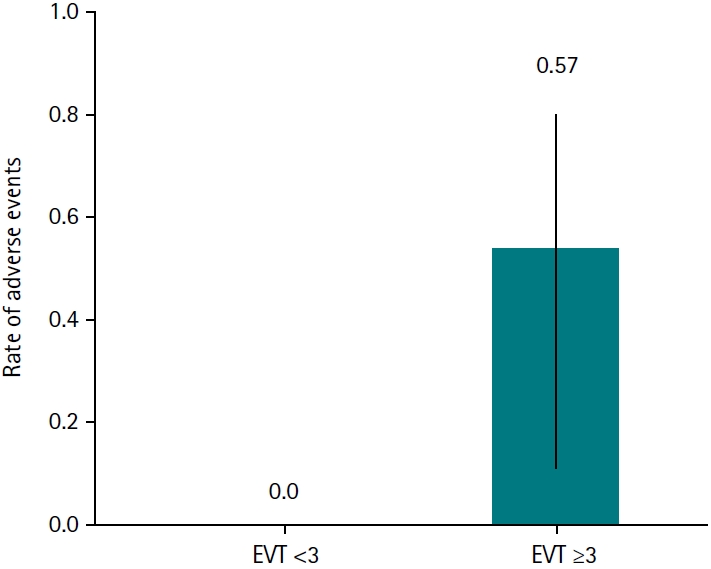
Fourteen patients were included (mean age, 63.9 years; 85.7% male). Stomach surgery was the most common etiology (50.0%), and malignancy accounted for 71.4% of cases. The median number of EVT sessions was 2.5, and the mean interval from the index event to the first EVT session was 10.5 days. EVT achieved a 100% technical success rate, with no 30-day mortality; there was 1 in-hospital death (7.1%), 2 cases of stricture (14.3%), and 1 major bleeding event (7.1%). Adverse events were observed more frequently in patients who underwent ≥3 EVT sessions (57.1%) compared with those who underwent <3 sessions, in whom no adverse events occurred.
Conclusion
This study suggests that EVT is a safe and effective treatment for gastrointestinal transmural defects, with high technical success rates. The number of EVT sessions and the timing of treatment initiation appeared to be associated with complications and overall clinical outcomes.
  • 78 View
  • 3 Download
Case Report
[English]
A Favorable Treatment Response of Erlotinib in Lung Adenocarcinoma with Concomitant Activating EGFR Mutation and ROS1 Rearrangement
Min Hwan Kim, Yehyun Park, Hye Jung Park, Ah-young Ji, Changho Song, Moo-Nyun Jin, Young Ju Kim, Sun Wook Kim, Jung-Hee Lee, In-Soo Kim, Hye Ryun Kim, Joohang Kim, Byoung Chul Cho
Ewha Med J 2014;37(1):46-51.   Published online March 25, 2014
DOI: https://doi.org/10.12771/emj.2014.37.1.46

The rearrangement of c-ros oncogene 1 (ROS1) has been recently identified as an important molecular target in non small cell lung cancer (NSCLC). ROS1 rearrangement and epidermal growth factor receptor (EGFR) mutation were mutually exclusive each other in previous studies, and the clinical implication of co-existence of the two genetic alterations has not been determined. We report a case of 46-year-old female never-smoker NSCLC patient whose tumor harbored ROS1 rearrangement and EGFR mutation concomitantly. She had undergone curative surgery for stage IIIA NSCLC, and the recurrence in left pleura and brain occurred at 2 years after the surgery. She received several lines of chemotherapy including docetaxel plus carboplatin, erlotinib, pemetrexed, and gemcitabine. Erlotinib therapy showed a favorable treatment response with progression-free survival of 9.5 months and partial response of tumor on radiologic evaluations. This case represents a successful erlotinib treatment in a NSCLC patient with concurrent ROS1 rearrangement and EGFR mutation.

  • 387 View
  • 0 Download
TOP