
• Contact us
  • E-Submission
ABOUT
BROWSE ARTICLES
JOURNAL POLICIES
FOR CONTRIBUTORS

Page Path

3
results for

"Jin Ju Lee"

Filter

Article category

Keywords

Publication year

Authors

"Jin Ju Lee"

Review article

[English]
Irritant contact dermatitis: beyond a diagnosis of exclusion
Da Yeon Kim, Jin Ju Lee, Hae Young Choi
Ewha Med J 2026;49(4):e27.   Published online October 2, 2026
DOI: https://doi.org/10.12771/emj.2026.01522
Irritant contact dermatitis (ICD) is the most common form of contact dermatitis and a leading cause of occupational skin disease, but remains underrecognized relative to allergic contact dermatitis (ACD). Direct chemical or physical injury to the epidermal barrier causes ICD, which can develop in anyone when exposure intensity or duration exceeds the skin’s repair capacity. ICD is increasingly understood to involve more than barrier disruption: it is an innate immune-mediated inflammatory disorder involving keratinocyte-derived cytokines, neutrophil recruitment, C-C motif chemokine ligand 2–C-C motif chemokine receptor 2–interleukin-1β signaling, Toll-like receptor 3, and inflammasome activation. Host factors, particularly atopic dermatitis and filaggrin loss-of-function variants, further influence susceptibility. Clinical phenotypes range from acute irritant reactions to chronic cumulative dermatitis, and occupational wet work is a major preventable exposure. Distinguishing ICD from ACD is difficult because their clinical and histopathological features overlap, they may coexist, and ICD-related barrier damage may facilitate subsequent allergic sensitization. Diagnosis therefore requires assessment of exposure history, lesion distribution, symptom quality, and temporal course, with patch testing when ACD is suspected. Molecular biomarker panels and noninvasive imaging or barrier-assessment techniques may improve diagnostic precision, but remain investigational. Management should prioritize identifying and removing irritants, reducing exposure, implementing appropriate protective measures, and restoring the epidermal barrier. Recognizing ICD as a distinct clinical entity, rather than simply a diagnosis of exclusion, is essential for accurate diagnosis and effective management of contact dermatitis in clinical practice.
  • 747 View
  • 39 Download

Original Article

[English]
No difference in inflammatory mediator expression between mast cell-rich and mast cell-poor rosacea lesions in Korean patients: a comparative study
Jin Ju Lee, Bo Ram Kwon, Min Young Lee, Ji Yeon Byun, Joo Young Roh, Hae Young Choi, You Won Choi
Ewha Med J 2025;48(1):e78.   Published online January 31, 2025
DOI: https://doi.org/10.12771/emj.2024.e78

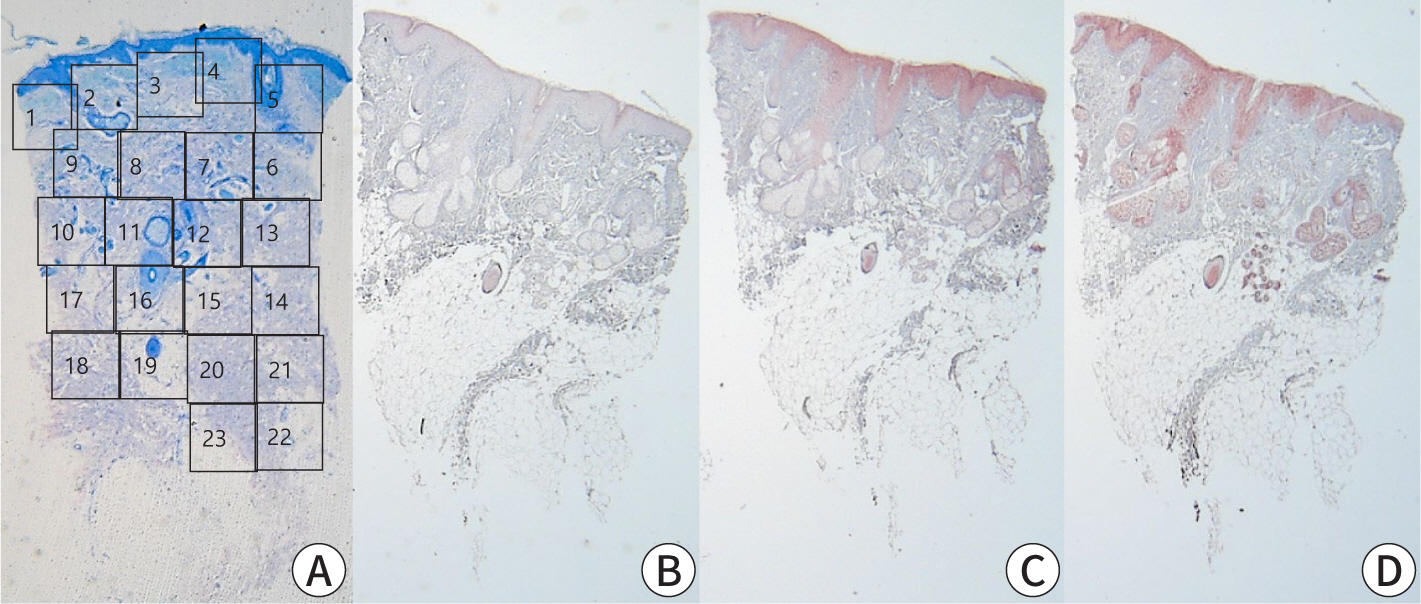
Objectives: This study aimed to evaluate the correlation between mast cell (MC) density in rosacea-affected skin and the expression of key inflammatory mediators, including IL-6, TNF-α, and cathelicidin LL-37. By comparing lesions rich in MCs with those having fewer MCs, we sought to elucidate the role of MCs in the inflammatory mechanisms underlying rosacea pathogenesis.

Methods: Specimens were collected from 20 patients diagnosed with rosacea who attended the outpatient clinic between 2008 and 2013. Each specimen underwent staining using hematoxylin/eosin, Giemsa, IL-6, LL-37, and TNF-α for both histopathological and immunohistochemical analyses. The number of stained cells was counted across 10 randomly selected dermal layers at a magnification of ×400 using light microscopy. The results were categorized based on the number of MCs counted: more than 10 MCs were classified as MC-rich, and 10 or fewer MCs as MC-poor.

Results: Among the 20 patients (10 MC-rich and 10 MC-poor), the MC-rich group demonstrated significantly higher MC counts than the MC-poor group (P<0.001). However, there were no significant differences in the expression levels of IL-6, LL-37, or TNF-α between the two groups. Additionally, MC density did not show any significant associations with patient demographics, clinical characteristics, or systemic comorbidities.

Conclusion: Increased MC density was not associated with differences in IL-6, TNF-α, or LL-37 expression in rosacea lesions. These findings suggest that MC infiltration may not directly influence the inflammatory mediator profile in rosacea. Further research is required to identify distinctive pathological features or markers that can elucidate the mechanisms of rosacea.

Citations

Citations to this article as recorded by  
  • Inflammatory memory as a potential driver of rosacea pathogenesis: integrating mechanisms of chronic relapse and perspectives on disease modification
    Ming Zhang, Zhou Zhou, Dandan Zhan, Yumeng Yang, Min Li
    Frontiers in Immunology.2026;[Epub]     CrossRef
  • 2,815 View
  • 31 Download
  • 2 Web of Science
  • 1 Crossref
Case Report
[English]
Nontuberculous mycobacterial infection in a sporotricoid distribution in Korea: a case report
Jin Ju Lee, Yoon Jin Choi, Ji Yeon Byun, You Won Choi, Joo Young Roh, Hae Young Choi
Ewha Med J 2024;47(2):e29.   Published online April 30, 2024
DOI: https://doi.org/10.12771/emj.2024.e29

Nontuberculous mycobacterial infections, which are often acquired from environmental sources such as water and soil, exhibit a variety of cutaneous manifestations that frequently lead to misdiagnoses and delays in treatment. A 77-year-old woman presented with multiple skin lesions in a sporotricoid distribution on her right leg, which persisted despite standard antibiotic treatments. Based on the skin biopsy, revealing granulomatous inflammation with acid-fast bacilli, and PCR testing, a nontuberculous mycobacterial infection was diagnosed. Antimycobacterial drug combinations, including clarithromycin, isoniazid, and rifampicin for 4 months, complete the skin lesion's clearance. This case underscores the need for heightened suspicion and the use of appropriate diagnostic techniques, including tissue biopsies and molecular methods such as PCR.

Citations

Citations to this article as recorded by  
  • Clarithromycin

    Reactions Weekly.2024; 2014(1): 180.     CrossRef
  • 2,454 View
  • 14 Download
  • 1 Crossref
TOP